All-on-4® explained: a full arch on four implants
Four implants, placed so that the two at the back lean forwards. It's a clever way to make the most of the bone at the front of the jaw.
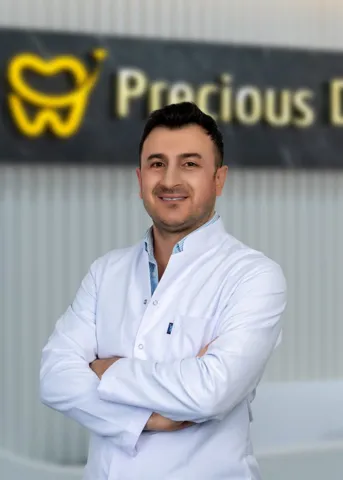 Medically reviewed by Dt. Hüseyin Yavuz Özbek, implant surgeon · Updated October 2026
All-on-4® is Nobel Biocare's name for a full arch of fixed teeth held by four implants: two upright at the front and two tilted at the back. Tilting the back implants lets them reach better bone and avoid the sinus or the nerve, which often means no bone graft. It suits many people with limited bone, but it isn't automatically better or worse than six.
What it is
All-on-4® is a way of giving you a complete row of fixed teeth, upper or lower, held by just four implants. The teeth are made as one bridge that's screwed onto the implants. It doesn't come out at night like a denture; only a dentist can remove it.
The name belongs to Nobel Biocare, which registered it as a treatment concept. In everyday use, many clinics say "All-on-4" for any four-implant full arch. That's fine, as long as you know which implants are actually being used.
How the four implants are placed
- Two at the front, usually upright, where the bone is often thickest.
- Two at the back, tilted forwards. In the upper jaw this keeps them in front of the sinus; in the lower jaw, in front of the nerve that runs through the bone.
Tilting does two useful things. A longer implant can sit in solid bone, and the back implant ends up further back in the mouth, so less of the bridge hangs out unsupported at the back.
Who it often suits
- People who have lost bone at the back of the jaw after years without teeth or with a denture
- People who'd like to avoid a bone graft or sinus lift if that's possible
- Lower jaws, where the bone at the front is usually dense
- People who want fewer implant sites and slightly shorter surgery
The limits, honestly
- Fewer supports. Each implant carries a bigger share of your bite.
- Less in reserve. If one of four implants fails, the bridge usually can't be used on three until it's replaced. What happens then.
- Upper jaws. A 2024 review of upper-jaw studies found more bone loss around implants with four than with six, although implant and bridge survival were similar.
Four isn't "the cheap option". It's a different way of using the bone you have. For some jaws it's the better plan; for others six is. The difference in price between the two is usually small. How the cost changes.
How it compares with six
Six implants spread the load more evenly and keep more in reserve, but need more bone along the jaw. Four makes the most of limited bone, often without grafting. Large research reviews have not found a significant difference in survival between the two. All-on-6 explained · the full comparison.
Want to know what living with a full arch is like, whichever number you have? See allon6implant.co.uk for recovery, eating and cleaning in detail.
Common questions
Is All-on-4 a brand?
All-on-4® is a registered trademark of Nobel Biocare for its treatment concept. Many clinics use the phrase loosely for any four-implant full arch, with implants from various makers. Ask which implant brand and system will actually be used.
Why are the back implants angled?
Angling lets a longer implant sit in better bone in front of the sinus (upper jaw) or the nerve (lower jaw). It also moves the back support further back, which shortens the part of the bridge that sticks out unsupported.
Can All-on-4 be done without a bone graft?
Often, yes. Avoiding a graft is one of the main reasons the concept was developed. Whether you need one depends on what your 3D scan shows.
Is four implants enough for an upper jaw?
Sometimes. Upper jaws usually have softer bone, and one review found more bone loss around implants when four were used rather than six. Many upper jaws are treated well with four; your dentist should explain why four or six suits yours.
Sources
- Nobel Biocare — All-on-4® treatment concept
- Justia — ALL-ON-4 trademark, owned by Nobel Biocare Services AG
- Sharaf et al. (2024), Heliyon — Four or six implants for maxillary fixed prostheses: systematic review and meta-analysis
- Oral Health Foundation — Understanding dental implants
Checked October 2026. Where we give our own view as a clinic, we say so.
Only a scan can settle it.
Send us an X-ray or scan if you have one. A dentist will tell you which option suits your bone, and say so honestly if neither is the right step.